<?xml version="1.0" encoding="utf-8"?><feed xmlns="http://www.w3.org/2005/Atom" ><generator uri="https://jekyllrb.com/" version="3.10.0">Jekyll</generator><link href="https://hugofloresgarcia.art/feed.xml" rel="self" type="application/atom+xml" /><link href="https://hugofloresgarcia.art/" rel="alternate" type="text/html" /><updated>2026-06-17T17:52:51+00:00</updated><id>https://hugofloresgarcia.art/feed.xml</id><title type="html">hugo flores garcía</title><subtitle>music 🤝 computers
</subtitle><entry><title type="html">Sketch2Sound</title><link href="https://hugofloresgarcia.art/sketch2sound-landing/" rel="alternate" type="text/html" title="Sketch2Sound" /><published>2024-12-11T00:00:00+00:00</published><updated>2024-12-11T00:00:00+00:00</updated><id>https://hugofloresgarcia.art/sketch2sound</id><content type="html" xml:base="https://hugofloresgarcia.art/sketch2sound-landing/"><![CDATA[<!-- https://oreillyp.github.io/tria/assets/video/tria_compressed.mp4 -->
<!-- (copilot: embed the video above) -->

<figure>
  <img src="/sketch2sound/figs/hero-figure.png" alt="" style="margin-bottom:2px; max-width: 1200px" />
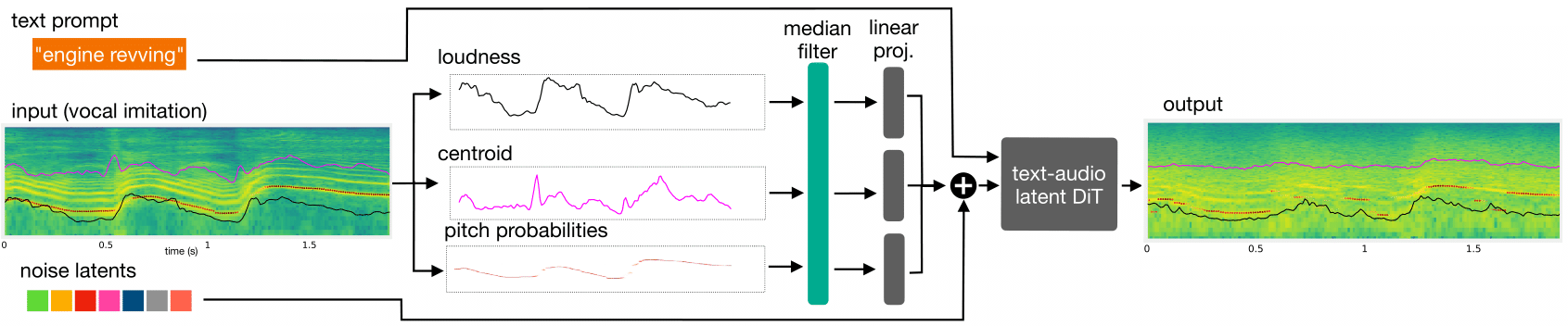
  <!-- <figcaption>Overview of Sketch2Sound. We extract three control signals from any input sonic imitation: loudness, spectral centroid (i.e., brightness) and pitch probabilities. We encode the signals and add them to the latents used as input to a DiT text-to-sound generation system.</figcaption> -->
</figure>

<p>Sketch2Sound is a generative audio model capable of creating high-quality sounds from a set of interpretable time-varying control signals: loudness, brightness, and pitch, as well as text prompts.</p>

<p><strong>Sketch2Sound can synthesize arbitrary sounds from sonic imitations</strong> (i.e., a vocal imitation or a reference sound-shape).</p>

<p>Check out our demo video, paper and website: <a href="/sketch2sound/">sketch2sound website</a></p>]]></content><author><name></name></author><category term="research" /><summary type="html"><![CDATA[]]></summary><media:thumbnail xmlns:media="http://search.yahoo.com/mrss/" url="https://hugofloresgarcia.art/assets/img/preview.png" /><media:content medium="image" url="https://hugofloresgarcia.art/assets/img/preview.png" xmlns:media="http://search.yahoo.com/mrss/" /></entry><entry><title type="html">The Rhythm In Anything (TRIA)</title><link href="https://hugofloresgarcia.art/tria.html" rel="alternate" type="text/html" title="The Rhythm In Anything (TRIA)" /><published>2024-09-14T00:00:00+00:00</published><updated>2024-09-14T00:00:00+00:00</updated><id>https://hugofloresgarcia.art/tria</id><content type="html" xml:base="https://hugofloresgarcia.art/tria.html"><![CDATA[<!-- https://oreillyp.github.io/tria/assets/video/tria_compressed.mp4 -->
<!-- (copilot: embed the video above) -->

<video width="30%" height="auto" controls="">
  <source src="https://oreillyp.github.io/tria/assets/video/tria_compressed.mp4" type="video/mp4" />
  Your browser does not support the video tag.
</video>

<p>Led by my labmate Patrick O’Reilly, TRIA (The Rhythm In Anything), takes as input two audio prompts – one specifying the desired drum timbre, and one specifying the desired rhythm – and synthesizes drum beats that follow the rhythm prompt, while keeping the timbre prompt (i.e. playing the desired rhythm with the desired timbre).</p>]]></content><author><name></name></author><category term="research" /><summary type="html"><![CDATA[]]></summary><media:thumbnail xmlns:media="http://search.yahoo.com/mrss/" url="https://hugofloresgarcia.art/assets/img/preview.png" /><media:content medium="image" url="https://hugofloresgarcia.art/assets/img/preview.png" xmlns:media="http://search.yahoo.com/mrss/" /></entry><entry><title type="html">Chicago Creative Machines</title><link href="https://hugofloresgarcia.art/ccm.html" rel="alternate" type="text/html" title="Chicago Creative Machines" /><published>2024-02-25T00:00:00+00:00</published><updated>2024-02-25T00:00:00+00:00</updated><id>https://hugofloresgarcia.art/ccm</id><content type="html" xml:base="https://hugofloresgarcia.art/ccm.html"><![CDATA[<iframe src="https://www.youtube.com/embed/NfhlRH5k-bg?si=PgSBUh-FuMliLWTB&amp;start=870" title="YouTube video player" height="auto" width="100%" allow="accelerometer; autoplay; clipboard-write; encrypted-media; gyroscope; picture-in-picture; web-share" allowfullscreen=""></iframe>

<p>I had the joy of giving the inaugural talk + performance for the <a href="https://chicagocreativemachines.com">Chicago Creative Machines</a> series at <a href="https://ess.org">ESS Chicago</a> on Feb. 25, 2024. I talked about my compositional work with <a href="/research">vampnet</a>, using the mouth as the interface for a generative model, showed an 8ch composition for voice and vampnet, and played a solo set of instrumental music with.</p>]]></content><author><name></name></author><category term="research" /><summary type="html"><![CDATA[]]></summary><media:thumbnail xmlns:media="http://search.yahoo.com/mrss/" url="https://hugofloresgarcia.art/assets/img/preview.png" /><media:content medium="image" url="https://hugofloresgarcia.art/assets/img/preview.png" xmlns:media="http://search.yahoo.com/mrss/" /></entry><entry><title type="html">VampNet - Music Generation Via Masked Transfomers</title><link href="https://hugofloresgarcia.art/ismir-vampnet.html" rel="alternate" type="text/html" title="VampNet - Music Generation Via Masked Transfomers" /><published>2023-07-09T00:00:00+00:00</published><updated>2023-07-09T00:00:00+00:00</updated><id>https://hugofloresgarcia.art/ismir-vampnet</id><content type="html" xml:base="https://hugofloresgarcia.art/ismir-vampnet.html"><![CDATA[<p>VampNet is a generative model for music that uses a masked token modeling technique to perform music generation and compression. We proposed new ways to prompt a generative model with music by masking out parts of some input with a meaningful mask structure, and have VampNet fill in the missing parts with new musical content. Check out the <a href="https://arxiv.org/abs/2307.04686">paper</a> and listen to <a href="https://hugo-does-things.notion.site/VampNet-Music-Generation-via-Masked-Acoustic-Token-Modeling-e37aabd0d5f1493aa42c5711d0764b33?pvs=4">audio samples</a>!</p>]]></content><author><name></name></author><category term="research" /><summary type="html"><![CDATA[VampNet is a generative model for music that uses a masked token modeling technique to perform music generation and compression. We proposed new ways to prompt a generative model with music by masking out parts of some input with a meaningful mask structure, and have VampNet fill in the missing parts with new musical content. Check out the paper and listen to audio samples!]]></summary><media:thumbnail xmlns:media="http://search.yahoo.com/mrss/" url="https://hugofloresgarcia.art/assets/img/research/vampnet-hero.png" /><media:content medium="image" url="https://hugofloresgarcia.art/assets/img/research/vampnet-hero.png" xmlns:media="http://search.yahoo.com/mrss/" /></entry><entry><title type="html">with the jack sundstrom quintet at Que4 Radio, Chicago, IL (2023)</title><link href="https://hugofloresgarcia.art/sundstrom-radio.html" rel="alternate" type="text/html" title="with the jack sundstrom quintet at Que4 Radio, Chicago, IL (2023)" /><published>2023-05-30T00:00:00+00:00</published><updated>2023-05-30T00:00:00+00:00</updated><id>https://hugofloresgarcia.art/sundstrom-radio</id><content type="html" xml:base="https://hugofloresgarcia.art/sundstrom-radio.html"><![CDATA[<p>I played a set of Jack’s original music with his quintet at Que4 Radio in Chicago, IL.</p>]]></content><author><name></name></author><category term="performances" /><summary type="html"><![CDATA[I played a set of Jack’s original music with his quintet at Que4 Radio in Chicago, IL.]]></summary><media:thumbnail xmlns:media="http://search.yahoo.com/mrss/" url="https://hugofloresgarcia.art/assets/img/performances/sundstrom-quintet.png" /><media:content medium="image" url="https://hugofloresgarcia.art/assets/img/performances/sundstrom-quintet.png" xmlns:media="http://search.yahoo.com/mrss/" /></entry><entry><title type="html">con el colectivo “los homies” en santé, teguciagalpa, honduras (2022)</title><link href="https://hugofloresgarcia.art/sante.html" rel="alternate" type="text/html" title="con el colectivo “los homies” en santé, teguciagalpa, honduras (2022)" /><published>2022-12-18T00:00:00+00:00</published><updated>2022-12-18T00:00:00+00:00</updated><id>https://hugofloresgarcia.art/sante</id><content type="html" xml:base="https://hugofloresgarcia.art/sante.html"><![CDATA[<p>el jam del año! con los homies: Michael Pineda, Fernando Orellana, Joyce Pineda, Daniel Nuñez, y Guillermo Arturo.</p>

<p>foto por Jumbo Producciones (Lizzie Diaz).</p>]]></content><author><name></name></author><category term="performances" /><summary type="html"><![CDATA[el jam del año! con los homies: Michael Pineda, Fernando Orellana, Joyce Pineda, Daniel Nuñez, y Guillermo Arturo.]]></summary><media:thumbnail xmlns:media="http://search.yahoo.com/mrss/" url="https://hugofloresgarcia.art/assets/img/performances/jumbo-prod-sante.png" /><media:content medium="image" url="https://hugofloresgarcia.art/assets/img/performances/jumbo-prod-sante.png" xmlns:media="http://search.yahoo.com/mrss/" /></entry><entry><title type="html">ISMIR 2022 Tutorial on Few-Shot and Zero-Shot Learning for MIR</title><link href="https://hugofloresgarcia.art/ismir-tutorial.html" rel="alternate" type="text/html" title="ISMIR 2022 Tutorial on Few-Shot and Zero-Shot Learning for MIR" /><published>2022-12-01T00:00:00+00:00</published><updated>2022-12-01T00:00:00+00:00</updated><id>https://hugofloresgarcia.art/ismir-tutorial</id><content type="html" xml:base="https://hugofloresgarcia.art/ismir-tutorial.html"><![CDATA[<p><a href="https://y-wang.weebly.com/">Yu Wang</a>, <a href="https://jeongchoi.home.blog/">Jeong Choi</a> and I gave a tutorial during ISMIR 2022 on few-shot and zero-shot learning centered around music information retrieval tasks. 
In this tutorial, we cover the foundations of few-shot//zero-shot learning, build standalone coding examples, and discuss the state-of-the-art in the field, as well as future directions.</p>

<p>The tutorial is available as a jupyter book <a href="https://music-fsl-zsl.github.io/tutorial/landing.html">online</a>.</p>]]></content><author><name></name></author><category term="research" /><summary type="html"><![CDATA[Yu Wang, Jeong Choi and I gave a tutorial during ISMIR 2022 on few-shot and zero-shot learning centered around music information retrieval tasks. In this tutorial, we cover the foundations of few-shot//zero-shot learning, build standalone coding examples, and discuss the state-of-the-art in the field, as well as future directions.]]></summary><media:thumbnail xmlns:media="http://search.yahoo.com/mrss/" url="https://hugofloresgarcia.art/assets/img/machine-learning.png" /><media:content medium="image" url="https://hugofloresgarcia.art/assets/img/machine-learning.png" xmlns:media="http://search.yahoo.com/mrss/" /></entry><entry><title type="html">a solo improvised, electronic set at the crowdpleaser (evanston, IL, may 2022)</title><link href="https://hugofloresgarcia.art/crowdpleaser.html" rel="alternate" type="text/html" title="a solo improvised, electronic set at the crowdpleaser (evanston, IL, may 2022)" /><published>2022-05-13T00:00:00+00:00</published><updated>2022-05-13T00:00:00+00:00</updated><id>https://hugofloresgarcia.art/crowdpleaser</id><content type="html" xml:base="https://hugofloresgarcia.art/crowdpleaser.html"><![CDATA[<p>I played a quick set of improvised music with drum loops, synthesizers and electric guitar at the crowdpleaser in Evanston, IL. one of the best tunes was my own rendition of “I love parmesan cheese”, a sound that was trending on tiktok at the time.</p>]]></content><author><name></name></author><category term="performances" /><summary type="html"><![CDATA[I played a quick set of improvised music with drum loops, synthesizers and electric guitar at the crowdpleaser in Evanston, IL. one of the best tunes was my own rendition of “I love parmesan cheese”, a sound that was trending on tiktok at the time.]]></summary><media:thumbnail xmlns:media="http://search.yahoo.com/mrss/" url="https://hugofloresgarcia.art/assets/img/performances/crowdpleaser.png" /><media:content medium="image" url="https://hugofloresgarcia.art/assets/img/performances/crowdpleaser.png" xmlns:media="http://search.yahoo.com/mrss/" /></entry><entry><title type="html">audacitorch (Audacity with Deep Learning)</title><link href="https://hugofloresgarcia.art/audacitorch.html" rel="alternate" type="text/html" title="audacitorch (Audacity with Deep Learning)" /><published>2021-12-03T00:00:00+00:00</published><updated>2021-12-03T00:00:00+00:00</updated><id>https://hugofloresgarcia.art/audacitorch</id><content type="html" xml:base="https://hugofloresgarcia.art/audacitorch.html"><![CDATA[<p>I contributed a deep learning framework and a deep model manager that connects to HuggingFace to Audacity. This project was funded by a <a href="https://summerofcode.withgoogle.com/archive/2021/projects/5097817919455232/">Google Summer of Code</a> grant. Read the <a href="https://www.audacityteam.org/gsoc-2021-work-product-source-separation-and-deep-learning-tools/">Work Product Summary</a>.</p>

<p>You can download Audacity with Deep Learning <a href="https://interactiveaudiolab.github.io/project/audacity.html">here</a>.</p>

<p>Take a look at the <a href="https://github.com/audacitorch/audacitorch">code</a>.</p>]]></content><author><name></name></author><category term="software" /><summary type="html"><![CDATA[I contributed a deep learning framework and a deep model manager that connects to HuggingFace to Audacity. This project was funded by a Google Summer of Code grant. Read the Work Product Summary.]]></summary><media:thumbnail xmlns:media="http://search.yahoo.com/mrss/" url="https://hugofloresgarcia.art/assets/img/research/audacitorch.png" /><media:content medium="image" url="https://hugofloresgarcia.art/assets/img/research/audacitorch.png" xmlns:media="http://search.yahoo.com/mrss/" /></entry><entry><title type="html">Deep Learning Tools for Audacity</title><link href="https://hugofloresgarcia.art/audacitorch.html" rel="alternate" type="text/html" title="Deep Learning Tools for Audacity" /><published>2021-11-02T00:00:00+00:00</published><updated>2021-11-02T00:00:00+00:00</updated><id>https://hugofloresgarcia.art/audacitorch</id><content type="html" xml:base="https://hugofloresgarcia.art/audacitorch.html"><![CDATA[<p><a href="https://aldo-aguilar.github.io/">Aldo Aguilar</a>, <a href="https://ethman.github.io/">Ethan Manilow</a> and I made a software framework that lets deep learning practitioners easily integrate their own PyTorch models into <a href="https://en.wikipedia.org/wiki/Audacity_(audio_editor)">Audacity</a>. This lets ML audio researchers put tools in the hands of sound artists without doing DAW-specific development work, which is often a long and arduous process in itself.</p>

<p>Learn more about it in our <a href="https://interactiveaudiolab.github.io/project/audacity.html">project page</a> :).</p>]]></content><author><name></name></author><category term="research" /><summary type="html"><![CDATA[Aldo Aguilar, Ethan Manilow and I made a software framework that lets deep learning practitioners easily integrate their own PyTorch models into Audacity. This lets ML audio researchers put tools in the hands of sound artists without doing DAW-specific development work, which is often a long and arduous process in itself.]]></summary><media:thumbnail xmlns:media="http://search.yahoo.com/mrss/" url="https://hugofloresgarcia.art/assets/img/research/audacitorch.png" /><media:content medium="image" url="https://hugofloresgarcia.art/assets/img/research/audacitorch.png" xmlns:media="http://search.yahoo.com/mrss/" /></entry></feed>